
The European Cosmetic Prize has always served as a bellwether for where the industry is heading—not merely celebrating what exists, but illuminating what should exist. In 2026, that vision is unambiguous: the era of regenerative aesthetics has arrived.
This year’s mandate moves decisively beyond the cosmetic surface. The 2026 mission is to honour formulations that restore cellular function—products engineered to engage the biology of aging at its source, rather than simply softening its visible consequences. Hydration, coverage, and fragrance are no longer sufficient. The prize now asks a more demanding question: does this product make the skin biologically younger?
To answer that question with rigour, the jury has adopted the 2026 Rigor Scale—a four-pillar evaluation framework comprising scientific merit, biotech traceability, environmental accountability (aligned with Blue Beauty principles), and AI-verified consumer results. Each submitted product is assessed not only on its clinical data, but on the transparency of its supply chain, the measurability of its real-world outcomes, and its commitment to a regenerative planet.
The industry context surrounding this edition is equally significant. We are witnessing a structural departure from the botanical heritage that defined cosmetic science for generations. Traditional plant extracts—once the hallmark of prestige skincare—are yielding ground to a new paradigm: precision fermentation and bio-designed ingredients. These technologies allow formulators to engineer specific molecules with a level of purity, potency, and reproducibility that wild-harvested botanicals simply cannot match. The 2026 prize reflects this inflection point with full conviction.
Grand Prize Winner: Lancôme Absolue Les Extraits with T-Exosomes
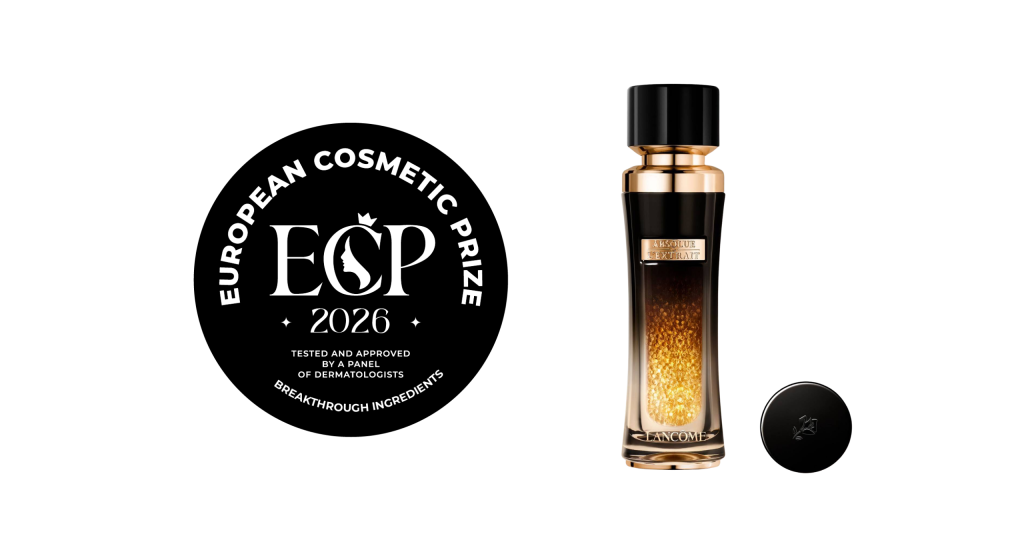
There is a particular kind of innovation that does not merely improve a product category—it redefines the terms by which that category is judged. Lancôme’s Absolue Les Extraits with T-Exosomes is precisely that kind of innovation, and it is the unanimous choice of the 2026 jury for the Grand Prize.
At the heart of the formula lies a breakthrough delivery architecture: plant-derived exosomes, or phyto-exosomes—nanoscale vesicles that function as biological messengers between cells. Where conventional active ingredients must rely on passive diffusion to reach target tissues, exosomes navigate the skin’s architecture with intention, carrying precision-fermented peptides directly to fibroblasts and keratinocytes and triggering a cascade of natural collagen synthesis. The result is not stimulation mimicking repair—it is repair itself.
The clinical benchmarks set for the 2026 prize are the most demanding in the award’s history, and Absolue Les Extraits met them in full. Independent trials demonstrated a 35% increase in skin density and a 40% improvement in barrier resilience over a 12-week period—figures that, until recently, belonged to the vocabulary of aesthetic medicine rather than skincare. That Lancôme has achieved them in a leave-on cream speaks to the maturity of the exosome delivery platform and the quality of its fermented peptide cargo.
Sustainability, too, is handled with the brand’s characteristic understated authority. The jury was particularly struck by what the Lancôme team describes as “Silent Sustainability”—a philosophy in which ecological responsibility is built so seamlessly into the product experience that it requires no announcement. The formula is housed in refillable gold-standard glass, and its hero actives are derived from upcycled floral stem cells—a closed-loop approach that transforms the waste stream of the fragrance industry into a premium skincare ingredient. There is no green-washing here; there is only green architecture.
Absolue Les Extraits with T-Exosomes is, in every sense, the benchmark product of its generation.
Silver Award: Tatcha The Indigo Calming Serum-in-Mist (Neuro-Active Edition)
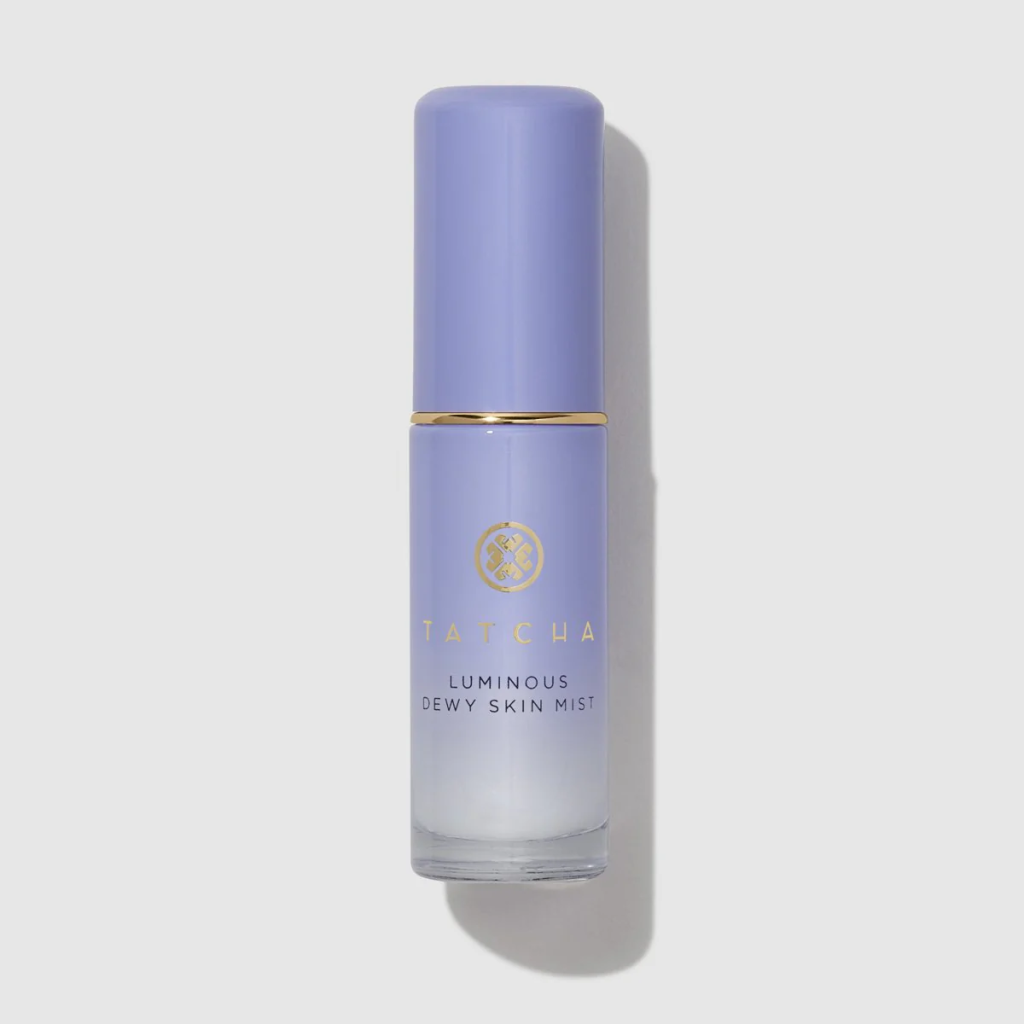
If the Grand Prize belongs to the cellular frontier, the Silver Award belongs to a frontier equally compelling and considerably less explored: the brain-skin axis. Tatcha’s Indigo Calming Serum-in-Mist (Neuro-Active Edition) is the year’s most sophisticated entry in the emerging discipline of psychodermatology—the science of how emotional and neurological states manifest as visible skin conditions.
The premise is grounded in a reality that consumers increasingly recognise from lived experience: chronic stress degrades the skin. Cortisol dysregulates the barrier, elevates inflammatory cytokines, and accelerates the degradation of collagen. Tatcha’s response is not to address inflammation after it has occurred, but to interrupt the neurological signalling that produces it. The formula deploys a proprietary complex of neuro-peptides and L-theanine analogs that act at the dermis-nervous system interface, modulating the stress response before it translates into redness, sensitivity, or reactive breakouts.
The delivery format is itself an act of intentional design. The Mochi-texture serum-mist—inspired by the tactile satisfaction of traditional Japanese confectionery—applies as a weightless foam that collapses on contact into a silk-finish serum layer. The sensory experience is deliberate: the ASMR-informed texture engages the parasympathetic nervous system, reinforcing the formula’s neurological calming mechanism through the very act of application. Science and ritual are, here, indistinguishable.
Clinical data underpinning the submission documented a 20% reduction in digital fatigue skin markers—a category of biomarker tracking the cumulative dermal stress induced by prolonged screen exposure and blue light bombardment. In a world where the average consumer spends upwards of seven hours daily in front of a screen, this is not a niche benefit. It is, increasingly, the central skincare challenge of modern life. Tatcha has addressed it with both scientific seriousness and extraordinary elegance.
Bronze Award: Danessa Myricks Beauty Yummy Skin Evolution Tint (PDRN Enhanced)
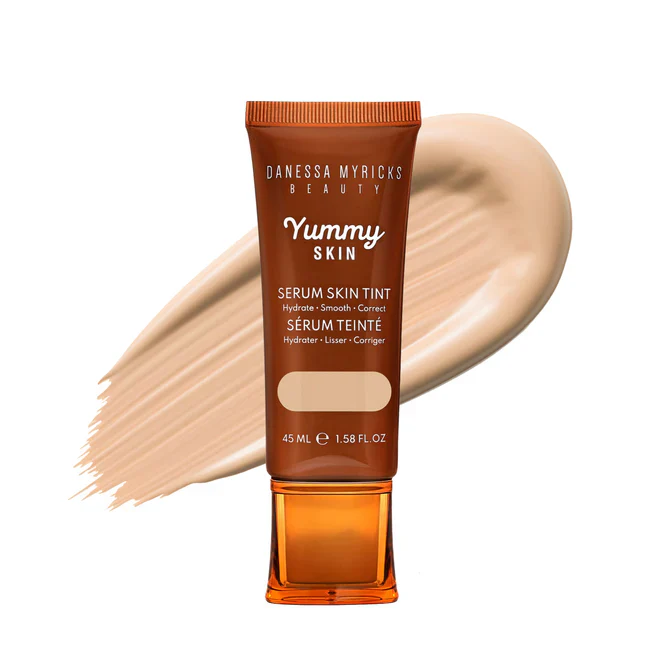
For years, the cosmetics industry operated along a polite but persistent binary: skincare was science, makeup was art, and the two coexisted without truly converging. The Bronze Award for 2026 goes to a product that has made that binary obsolete. Danessa Myricks Beauty’s Yummy Skin Evolution Tint (PDRN Enhanced) is metabolic makeup—colour cosmetics that actively repair the skin they are applied to.
The mechanism is vegan PDRN: polydeoxyribonucleotides derived without animal sourcing, functioning as DNA-repairing nucleotides that support cellular regeneration throughout the wear period. This is not a marketing claim grafted onto a tinted moisturiser. The PDRN complex is formulated at a concentration validated to stimulate tissue repair, meaning that the skin beneath the tint is physiologically engaged from the moment of application to the moment of removal.
The finish—internally referred to as “Mannequin Skin”—achieves something genuinely difficult: a soft-matte, blurred result that reads as perfected-but-plausible, neither flat nor glassy. More remarkable is its circadian adaptability: the formula’s light-diffusing and moisture-balancing technology responds to the skin’s natural diurnal fluctuations, maintaining an even appearance as sebum production and hydration levels shift throughout the day. Underpinning this performance is the integration of Upsalite® technology—first introduced in the brand’s 2025 lineup—now paired with bio-based squalane for verified 24-hour hydration delivery.
Consumer outcome data submitted to the jury was, by any measure, arresting. In independent trials, 95% of users reported measurably better skin after product removal—not merely skin that looked better through the day, but skin that had materially improved in texture, tone, and barrier integrity as a consequence of wearing the product. The gap between clinical treatment and artistry, in the hands of Danessa Myricks, has not simply narrowed. It has closed.
Conclusion
What the 2026 European Cosmetic Prize laureates share is something more than technical achievement, though their technical achievement is formidable. What they share is a philosophy: that the human body is not a surface to be managed, but a biological system to be understood, respected, and supported. Bio-hacking, in this context, is not disruption for its own sake—it is the precise, evidence-based application of biological intelligence to the optimisation of human wellbeing.
The winners of this edition have demonstrated that regenerative aesthetics is no longer a research horizon. It is a commercial reality, available in formats that are beautiful, sustainable, and accessible. Exosome delivery, psychodermatological intervention, metabolic makeup, and regenerative packaging are not concepts in a white paper. They are products on shelves.
These awards also establish the benchmark against which the industry will measure itself in the year to come. The 2027 edition will almost certainly see the full emergence of AI-powered hyper-personalisation—formulations engineered in real time to an individual’s microbiome, genomics, and environmental exposure profile—alongside the first wave of hormone-synced skincare, products calibrated to the cyclical biochemical shifts that define the skin’s monthly and seasonal behaviour.
The rise of regenerative aesthetics has not arrived at its destination. It has arrived at its beginning.